Let’s keep in touch!
The latest news of the Metis Fund, delivered straight to your inbox!

‘People will forget what you said, they’ll forget what you did, but they’ll never forget how you made them feel.’ MAYA ANGELOU


At the crossroads of artistic and documentary research, this initiative explores cocoa cultivation in Asia. The project aims to shed light on the little-known history of cocoa on the continent, as well as the social, economic, and environmental realities it generates.
Cocoa’s Journey
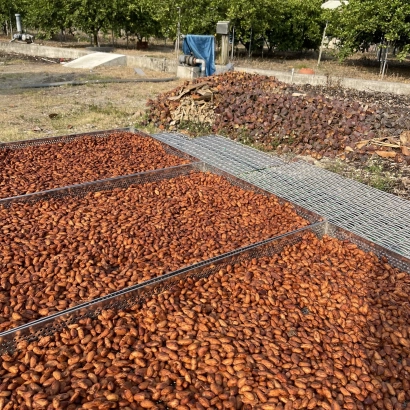
Originally from Central and South America, cocoa was introduced to Asia in the 16th century by Spanish and Dutch colonisers. Today, Asia produces around 13% of the world’s cocoa, with Indonesia accounting for the largest share. Yet local cocoa processing into chocolate remains limited, as the market is largely dominated by Western companies.
The rise of cocoa production in Asia raises major social and ecological challenges. While it supports local entrepreneurship, it also contributes to deforestation and environmental imbalance—particularly in Sulawesi (Indonesia), where many cocoa plantations have replaced tropical forests.
original artworks
countries involved in the touring exhibition
artists involved
The project, titled In Stranger Lands: Cocoa’s Journeys to Asia, unfolds across several components. First, sixteen contemporary artists from various Asian countries create works inspired by cocoa cultivation, exploring themes ranging from colonial history to environmental impact. These creations—sculpture, photography, and multimedia installations—were presented in a travelling exhibition across several Asian countries, including the Philippines.
In parallel, extensive research and documentation work is conducted on local plantations, with the involvement of researchers and industry stakeholders. Testimonies, stories, and archival materials enrich a deeper reflection on the multiple dimensions of cocoa. Finally, public workshops and talks allow artists, farmers, researchers, and citizens to meet and exchange, making cocoa a focal point connecting art with environmental and social development.
The latest news of the Metis Fund, delivered straight to your inbox!
‘People will forget what you said, they’ll forget what you did, but they’ll never forget how you made them feel.’ MAYA ANGELOU