Let’s keep in touch!
The latest news of the Metis Fund, delivered straight to your inbox!

‘People will forget what you said, they’ll forget what you did, but they’ll never forget how you made them feel.’ MAYA ANGELOU


In the heart of the Sundarbans, the world’s largest mangrove forest in Bangladesh, artists and villagers come together to shape a collective artwork built around two protective symbols: the Nojor Phôta and the Wish Fish.
The Journey of the Wish-Fish
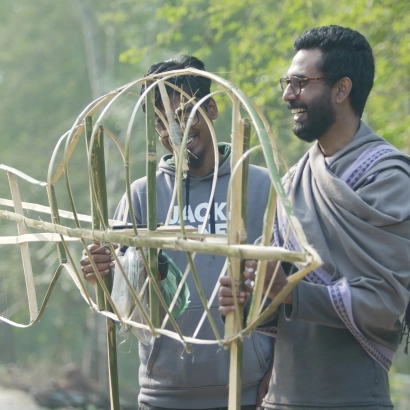
Communities in the Ganges Delta in Bangladesh live in close relationship with nature. Their lives are tied to the ocean—though it remains invisible. Protected by the mangrove forest yet exposed to storms, rising waters, and erosion, they adapt their daily lives to the rhythm of the seasons: salinity and extreme heat in summer, floods during the monsoon, and reconstruction in winter. Amid this unstable cycle, traditions and local rituals remain essential tools for navigating upheaval.
day creative workshop with the local community
animated short film and one documentary video
participants, including 40 children, took part in the workshops
Nine artists visited the residents of Dhangmari. Together, they brought to life an artwork rooted in a shared cultural symbol: the Nojor Phôta, the protective black dot drawn on children’s foreheads to ward off evil spirits. Between tale and reality:
“On the appointed day, a hundred residents of the village of Dhangmari lovingly place a nojor phôta—a sacred black dot—on the beings and things they wish to protect: a tree, a rice field, water, spinach, a house, a child’s birth certificate…
That night, once the community is asleep, all the nojor phôta gather and unite to form a great Wish Fish…”
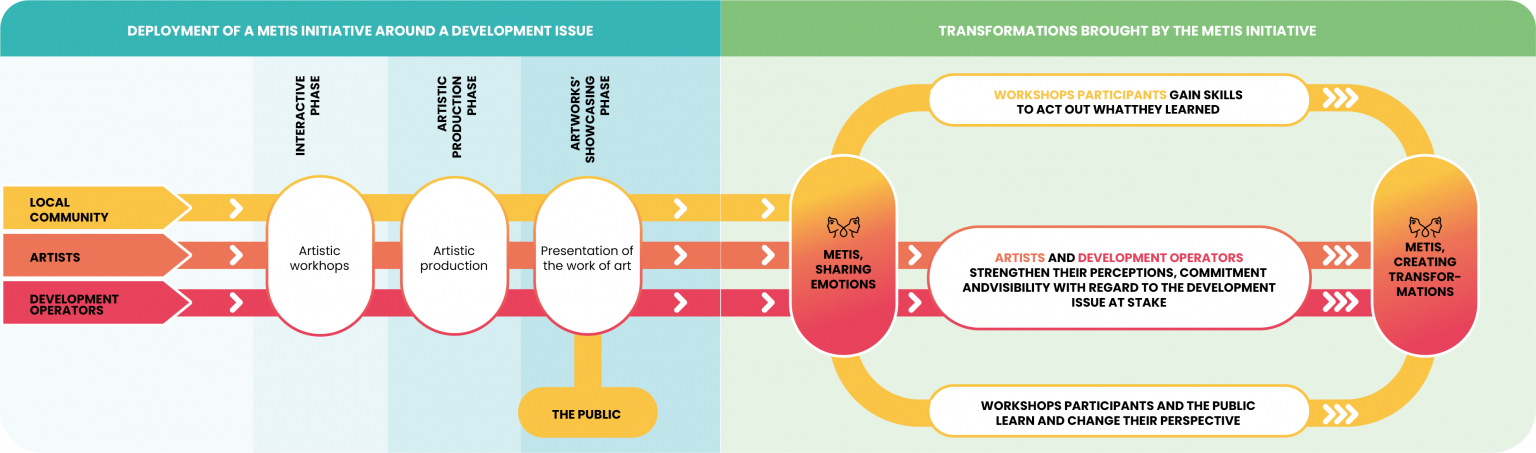
Birth of a Wish Fish is a performative artwork combining the participatory development of a story, the creation of an artwork, and its installation. The project unfolded over several months and concluded with an open-air exhibition in Dhangmari showcasing creations by artists and villagers alike: paintings, ritual objects, photographs, readings, performances, sound narratives, and a publication animated through augmented reality. Around sixty participants aged 6 to 72 took part in the workshops.
This exhibition will later be presented in Dhaka, the country’s capital. The project highlights a cultural richness that is under threat yet very much alive, carried by residents deeply attached to their land.
The latest news of the Metis Fund, delivered straight to your inbox!
‘People will forget what you said, they’ll forget what you did, but they’ll never forget how you made them feel.’ MAYA ANGELOU