Let’s keep in touch!
The latest news of the Metis Fund, delivered straight to your inbox!

‘People will forget what you said, they’ll forget what you did, but they’ll never forget how you made them feel.’ MAYA ANGELOU


In Lima, women come together to share their memories and struggles through theatre, turning the stage into a space for healing and social transformation.
A land of utopias
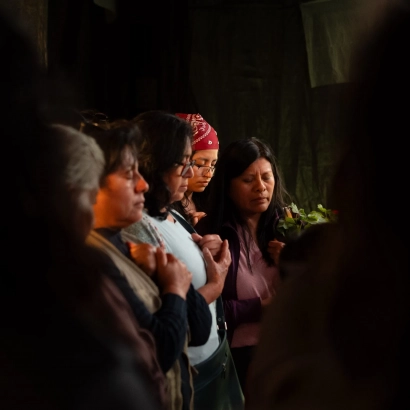
Villa El Salvador, south of Lima, was founded in the early 1970s by Andean migrant families. Born out of collective action and a desire for social justice, its pioneering organisational model enabled residents to structure their territory on a self-managed basis, coordinating collective work and access to education and health services. Long cited as a model of citizen participation, the city is now facing rapid urbanisation and profound social and gender inequalities.
Women are on the front line, taking on the work of care and solidarity. They run mutual aid networks, organise collective kitchens and support the most vulnerable households, while remaining largely invisible in the public sphere. Exposed to structural violence and the devaluation of their activities, they nevertheless play a central role in social cohesion.
collective theatre production
public performances
people reached
Led by the Vichama Teatro collective, founded forty years ago and renowned for its commitment to community theatre, the project is based in Villa El Salvador alongside the Promotoras Legales y de Salud — a women’s collective that has been providing legal and health support since 2008 — and the República de Nicaragua public secondary school.
It brings together 25 women, aged 18 to 60, including a dozen community health workers committed to helping women who are victims of violence, as well as 70 high school students, around 20 of whom are directly involved in the creative process.
Workshops focusing on the body, voice and memory invite participants to revisit their life stories, their experiences of violence and their practices of solidarity. Symbolic journeys and sensitive maps of the neighbourhood anchor these stories in the lived space. At the same time, the work carried out with the high school students opens up a dialogue between generations and prepares the ground for the shared theatrical creation.
Based on the testimonies collected, the group develops a collective work: writing scenes and dialogues, integrating songs and oral narratives, with dramaturgical formatting provided by Vichama Teatro.
The play is performed three times in public, each performance followed by a forum for discussion on gender-based violence, the place of women in care work and the prospects for social transformation.
The latest news of the Metis Fund, delivered straight to your inbox!
‘People will forget what you said, they’ll forget what you did, but they’ll never forget how you made them feel.’ MAYA ANGELOU