Let’s keep in touch!
The latest news of the Metis Fund, delivered straight to your inbox!

‘People will forget what you said, they’ll forget what you did, but they’ll never forget how you made them feel.’ MAYA ANGELOU


This initiative supports women artists from ethnic minorities in Rajasthan by encouraging them to preserve the traditional Mandana painting style and promote harmonious coexistence between humans and nature.
When mandana art opens a path to women’s empowerment
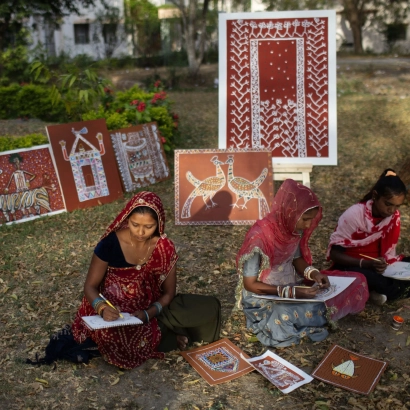
Ethnic minorities in Rajasthan have a rich cultural heritage and artistic expression that reflects their deep connection with nature. The ancestral practice of Mandana painting—composed of diagrams and geometric motifs created by women from the Sahariya and Bhil communities—illustrates this profound bond with the environment. Yet despite the richness of their art, these women face economic hardship and have limited access to markets.
women trained in tribal art practice and marketing
permanent mural painted in the city of Udaipur
artworks created and sold at the exhibition
Led by the NGO Kotra Adivasi Sansthan, this initiative involves 75 women artists from self-help groups across Rajasthan. They receive training in traditional art forms, financial literacy, and entrepreneurship. Over several months, workshops take place in Udaipur, Shahbad, and Jaipur, allowing participants to refine their skills in Mandana and other traditional arts. These sessions also introduce artistic marketing strategies, contributing to greater financial autonomy.
One of the highlights of the initiative is the creation of a large-scale mural in Udaipur. Painted by young girls from forest village schools, the mural offers a long-lasting tribute to the project’s mission, reinforcing the link between traditional art and nature conservation.
In addition, an art exhibition at Bagore Ki Haveli—organized by the West Zone Cultural Centre (WZCC)—displays and sells the participants’ work. This exhibition generates income while expanding the visibility of these unique art forms.
Beyond these immediate activities, the project’s final phase aims to replicate the methodology in other regions. By sharing the knowledge and skills gained through the initiative, more communities across Rajasthan can benefit from strengthened artistic training and new economic opportunities.
This initiative gives women artists from Rajasthan’s ethnic minorities a platform to preserve their cultural heritage while achieving financial independence—showing how art can become a powerful driver of social and environmental impact.
The latest news of the Metis Fund, delivered straight to your inbox!
‘People will forget what you said, they’ll forget what you did, but they’ll never forget how you made them feel.’ MAYA ANGELOU