Let’s keep in touch!
The latest news of the Metis Fund, delivered straight to your inbox!

‘People will forget what you said, they’ll forget what you did, but they’ll never forget how you made them feel.’ MAYA ANGELOU


In Ganvié, a lakeside village on Lake Nokoué in Benin, children express their territory through drawing, colour and patterns. Pirogues and sails become canvases for shared expression and creation.
Living on the lake
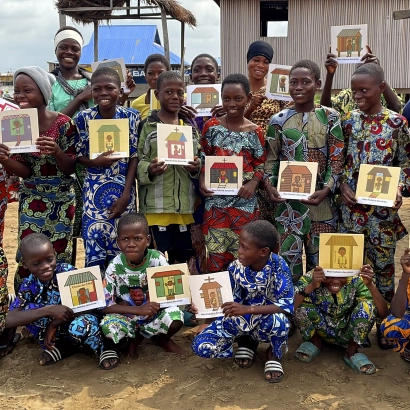
In southern Benin, 30 kilometres from Cotonou, Ganvié is a lakeside town on Lake Nokoué. Founded in the 18th century by people fleeing slave raids, it is a major part of Benin’s heritage. The organisation of the town, which now has a population of nearly 50,000, is entirely based on water: houses on stilts, travel by pirogue, economic activities linked to the lake. Despite a strong cultural identity, the availability of spaces and facilities dedicated to artistic creation remains limited, particularly for children and teenagers.
weeks of workshops
children and teenagers involved
artistic disciplines mobilised
Designer and visual artist Mahugnon Sognigbé Aka Cortex Asquith S has developed a practice that combines visual creation, research and transmission. With the Awadakpèkpè project, he is setting up a series of art workshops for young people in Ganvié.
The first workshop focuses on narrative illustration: participants create stories inspired by their everyday environment, and the results are then printed in booklets, stickers and playing cards. The second workshop is devoted to textile design: patterns are painted on cotton sheets, which are then used as sails for the boats at the floating market. The third workshop involves painting taxi boats with patterns inspired by the history and founding stories of the lakeside city. The children mainly paint animal figures, such as sparrowhawks and crocodiles. These patterns are inspired by the legend that the founder of Ganvié transformed himself into a bird and then a reptile to guide his people to the protective waters of Lake Nokoué.
The boats thus become mobile works of art, circulating on the lake like so many stories in motion.
This initiative supports the efforts of local authorities to promote the heritage and attractiveness of the region and to use creativity as a lever for transmission and emancipation.
The latest news of the Metis Fund, delivered straight to your inbox!
‘People will forget what you said, they’ll forget what you did, but they’ll never forget how you made them feel.’ MAYA ANGELOU